Electronics Emporium Easy Simple Voltage Controlled Oscillator VCO Circuit Diagram Visualize a gadget that makes sounds like a whistle, but you can control how high or low the pitch is with a knob.. That is kind of what a voltage controlled oscillator VCO circuit does.. It is an electronic device that creates a continuous signal often a square wave and uses a voltage to change how fast that signal vibrates, making the sound higher or lower.

The circuit as shown in Figure below presents a 555 as an extremely simple, voltage-controlled oscillator (VCO). The VCO's output frequency (U1) differs contrariwise with the input voltage. Using a 1 V input, the oscillator's output frequency is around 1500 Hz. If you supply a 5-V input, the oscillator's output frequency dips to about 300 Hz. A voltage controlled oscillator or VCO is an oscillator circuit which generates a signal with a frequency value varies with the instantaneous input voltage. In this VCO, the Analogread pin A0 is connected to wiper pin of the potentiometer. The terminal T1 of the potentiometer is connected to the 5V pin and the other terminal T2 to the GND.

How to Make a Voltage Circuit Diagram
Oscillator Design. According to the book Oscillator Design and Computer Simulation, a bipolar junction transistor (BJT) can be a good choice for an oscillator in the VHF or UHF range. The book describes an example 300 MHz oscillator using a series inductor and capacitor (LC) circuit (L1 and C6 in the circuit diagram below, 100nH and 3pF
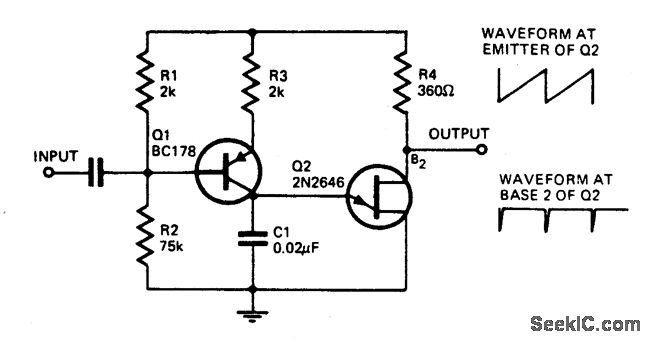
The voltage controlled oscillator (VCO) circuit that we will build using a 555 timer is shown below. The breadboard schematic of the above circuit is shown below. So we will now explain the workings of this circuit. Pin 5 is the control voltage pin. To this pin, we connect a potentiometer to. One end of the potentiometer is connected to

Controlled Oscillator (VCO) Circuit Diagram
Oscillator Design •Introduction -What makes an oscillator? -Buffered output -isolation -Bias circuits -Voltage control -Phase noise. 2 Oscillator Requirements •Power source •Frequency-determining components •Active device to provide gain •Positive feedback •Simple, Stable, Popular •Uses resistor and capacitor
